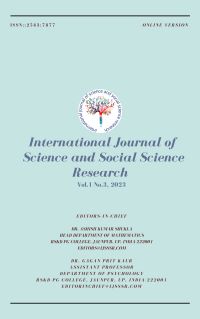
Impact of Emotional Well-being on Teaching Effectiveness
DOI:
https://doi.org/10.63671/ijsssr.v1i3.574Keywords:
Emotional Well-being, Teaching Effectiveness, School Teacher, Teacher Performance, Emotional Intelligence, Job Satisfaction, Classroom ManagementAbstract
This study investigates the impact of emotional well-being on teaching effectiveness among school teachers. Emotional well-being plays a crucial role in shaping teachers’ attitudes, classroom behavior, and instructional practices. A sample of 200 school teachers was selected using random sampling. Standardized tools were used to measure emotional well-being and teaching effectiveness. Statistical techniques such as mean, standard deviation, correlation, and t-test were applied. The findings revealed a significant positive relationship between emotional well-being and teaching effectiveness. Teachers with higher emotional well-being demonstrated better classroom management, instructional clarity, and student engagement. The study highlights the importance of promoting teachers’ emotional health to enhance overall educational quality.
Downloads
Published
Issue
Section
License
Copyright (c) 2023 International Journal of Science and Social Science Research

This work is licensed under a Creative Commons Attribution 4.0 International License.
How to Cite
Similar Articles
- N. Rajitha, K. Venugopala Rao, Assessing Work-Life Integration for Women in the IT Industry , International Journal of Science and Social Science Research: Vol. 3 No. 4: January-March 2026
- Pech Rathana, Seour Somalineth, The School Leaders’ Roles In Promoting Effective Assessment: An Investigation On Effectiveness Of Assessment Policy Implementation , International Journal of Science and Social Science Research: Vol. 2 No. 4: January-March 2025
- Ruhi Afreen, B Anitha, Role of Talent Analytics in Strategic Human Resource Decision Making , International Journal of Science and Social Science Research: Vol. 4 No. 1: April-June 2026
- Sachin Kumar, From Imagination to Automation: How AI is Reshaping Students Creativity in the Digital Age , International Journal of Science and Social Science Research: Vol. 3 No. 4: January-March 2026
- Judit Katalin FEJES, Etelka KATITS, Zoltán SZABÓ, The Future of Spa Towns: Integrating Traditional and AI-Based Tools for Sustainable Tourism , International Journal of Science and Social Science Research: Vol. 3 No. 2: July-September 2025
- Judit Katalin Fejes, Etelka Éva Katits, Developing Early Warning Systems in the Era of Company Crisis Prevention , International Journal of Science and Social Science Research: Vol. 3 No. 2: July-September 2025
- Judit Katalin Fejes, Etelka Éva Katits, CryptoLife HYDRA-SAI Framework for Investor Decision Support , International Journal of Science and Social Science Research: Vol. 3 No. 4: January-March 2026
- Ajeet Kumar Yadav, Kusum Lata Patel, Teachers’ Perception towards the Use of Information and Communication Technology (ICT) in Secondary School , International Journal of Science and Social Science Research: Vol. 2 No. 1: April-June 2024
- Harsh Shukla, Kshama Pandey, Human-AI Collaboration in Teaching and Learning , International Journal of Science and Social Science Research: Vol. 2 No. 4: January-March 2025
- Aqsa Khalid, A Research on “The Paradigm Shifts of Marketing from 1.0 to 5.0”: With Special Reference to Marketing shifts in the FMCG sector , International Journal of Science and Social Science Research: Vol. 1 No. 2: July-September 2023
You may also start an advanced similarity search for this article.