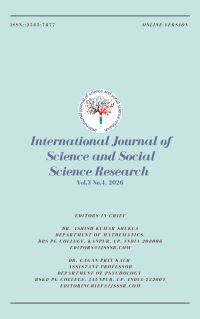
M = ∫ [I(t) + E(t) + C(t)] dt : The Gorkhaland Movement as the Integral of Unresolved Identity, Economic, and Cultural Grievances
DOI:
https://doi.org/10.63671/ijsssr.v3i4.521Keywords:
Gorkhaland Movement, Identity grievance (I(t)), Economic grievance (E(t)), Cultural grievance (C(t)), Gorkha identityAbstract
The article “M = ∫ [I(t) + E(t) + C(t)] dt : The Gorkhaland Movement as the Integral of Unresolved Identity, Economic, and Cultural Grievances” proposes a novel theoretical framework for analyzing protracted sub-national movements. It argues that the decades-long Gorkhaland agitation in the Darjeeling hills of India cannot be understood through a singular lens of ethnic nationalism or political aspiration. Instead, the movement (M) is conceptualized as the historical integral—the accumulated sum over time—of three dynamically interacting and mutually reinforcing streams of grievance: Identity (I(t)), Economic (E(t)), and Cultural (C(t)). The paper demonstrates that while the demand for a separate state is framed in political-administrative terms, its persistence is fueled by the continuous and unresolved nature of these core grievances. The identity grievance (I(t)) stems from a distinct Nepali-Indian (Gorkha) identity seeking political recognition beyond the state of West Bengal. The economic grievance (E(t)) is rooted in perceived systemic neglect, underdevelopment, and a lack of local control over resources like tea and tourism. The cultural grievance (C(t)) involves threats to linguistic preservation and cultural practices. By treating these not as static factors but as functions of time (t) that intensify, diminish, and interact in response to state policies and historical events, the model explains the movement’s cyclical nature and enduring resonance. The article concludes that a sustainable resolution requires addressing not just the political demand for statehood, but the definitive resolution of this integral—the underlying calculus of identity, economy, and culture that has defined the Gorkhaland movement for over a century.
Downloads
Published
Issue
Section
License
Copyright (c) 2026 International Journal of Science and Social Science Research

This work is licensed under a Creative Commons Attribution 4.0 International License.

How to Cite
Similar Articles
- Samir Pramanik, Bela Das, Spatial Interaction and Borderland Dynamics: A Geographical Analysis of Jhargram–Purulia–Jharkhand Region , International Journal of Science and Social Science Research: Vol. 3 No. 4: January-March 2026
- Ruby Singh, Aseem Tripathi, Kamala Das in a Postcolonial Context: Language, Power and Resistance , International Journal of Science and Social Science Research: Vol. 3 No. 1: April-June 2025
- Ranganath, C. Viswanatha Reddy, Financial Management Practices and Performance Efficiency of Cement Companies in Andhra Pradesh: An Empirical Study , International Journal of Science and Social Science Research: Vol. 3 No. 3: October-December 2025
- Ranjita Marak, Deepa Mehta, Standard vs. Native: The Linguistic Dilemma of First-Generation Tribal Learners in West Bengal , International Journal of Science and Social Science Research: Vol. 3 No. 1: April-June 2025
- Elena Saithuami Sailo, Arundhati Devi Maibam, Intergenerational Values and Cultural Continuity in Mizo Folktales , International Journal of Science and Social Science Research: Vol. 4 No. 3: October-December 2026
- R.D. Singh, C.S. Armo, System approach to sustainable development , International Journal of Science and Social Science Research: Vol. 2 No. 1: April-June 2024
- Laishram Amitraraj Singh, Yumnam Nita Devi, Balancing Home and Livelihood in traditional Meitei Society: A case study of Housewives in Wabagai Village , International Journal of Science and Social Science Research: Vol. 3 No. 3: October-December 2025
- Munmi Gogoi, Bikash Deka, Traditional Food Culture of the Mising Community in Assam: A Study , International Journal of Science and Social Science Research: Vol. 4 No. 1: April-June 2026
- Dr. Asaikkannu Sakthivel, Dr. Kartheges Ponniah, Dr. Aayushi Sharma, Dr. Franklin Thambi Jose Selistus Darling, Lexical Identity and Linguistic Resilience of South Indian Malayali Tribes , International Journal of Science and Social Science Research: Vol. 4 No. 3: October-December 2026
- N. Sathiyarajan, P. Kalaiselvi, V. Arthy, J. Asvin, Gender, Sexual Identity, and Resilience: A Queer Analysis of Forbidden Love in Chinelo Okparanta's Under the Udala Tress , International Journal of Science and Social Science Research: Vol. 3 No. 1: April-June 2025
You may also start an advanced similarity search for this article.
Most read articles by the same author(s)
- Lekhraj Balmiki, Tribal Consciousness in Darjeeling Hills: A Case Study of Lepcha Community , International Journal of Science and Social Science Research: Vol. 2 No. 2: July-September 2024