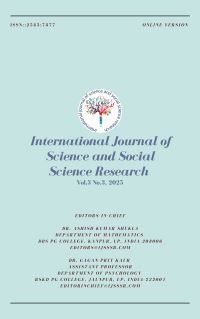
The Article 19 of the Indian Constitution: Scope, Limitations, and Contemporary Challenges
DOI:
https://doi.org/10.63671/ijsssr.v3i3.478Keywords:
Indian constitution, Article 19, rights, freedom, DemocraticAbstract
Article 19 of the Indian Constitution guarantees six fundamental freedoms—speech and expression, peaceful assembly, association, movement, residence, and profession—that together form the foundation of India’s democratic system. While these rights safeguard individual liberty and political participation, they are not absolute; the Constitution authorizes the State to impose reasonable restrictions in the interest of sovereignty, security, morality, and public order. This paper examines the scope and significance of these freedoms, analyzes constitutional limitations through landmark judicial interpretations, and highlights contemporary challenges such as digital censorship, hate speech, internet shutdowns, and restrictions on protests. By tracing the balance between liberty and regulation, the study underscores the evolving relevance of Article 19 in safeguarding democratic values in a complex and changing socio-political landscape.
Downloads
Published
Issue
Section
License
Copyright (c) 2025 International Journal of Science and Social Science Research

This work is licensed under a Creative Commons Attribution 4.0 International License.

How to Cite
Similar Articles
- Sarika Bilung, Article 368: Power to amend the constitution and the Fundamental Rights of India , International Journal of Science and Social Science Research: Vol. 1 No. 3: October-December 2023
- B. Ramprasad Naik, Abraham Lincoln, Tribal Infrastructure as A Constitutional and Human Rights Imperative: A Comparative Analysis of Indian Jurisprudence and International Law , International Journal of Science and Social Science Research: Vol. 3 No. 4: January-March 2026
- Ratna Sekhar Potineni, K. Abraham Lincoln, Dr. Ambedkar views on Dalit Women Empowerment to the Contemporary Andhra Pradesh Society , International Journal of Science and Social Science Research: Vol. 3 No. 3: October-December 2025
- H. M. Sudharshana, Violation of Human Rights of Women in India- Problems & Prospective , International Journal of Science and Social Science Research: Vol. 1 No. 4: January-March 2024
- Dr. Giriraj Singh Chauhan, Constitutional Democracy in India: The Past, The Present and The Future , International Journal of Science and Social Science Research: Vol. 4 No. 1: April-June 2026
- Neeru Sharma, ndia-Afghanistan Relations – Post US Withdrawal , International Journal of Science and Social Science Research: Vol. 2 No. 2: July-September 2024
- Jhilike Saha, Unifying The Fragmented: An In-depth Analysis of Identity Politics in Ethnic Conflict of Manipur , International Journal of Science and Social Science Research: Vol. 1 No. 3: October-December 2023
- Nibedita Pal, Indian Women and Sister Nivedita: A Campaigner of Female Education , International Journal of Science and Social Science Research: Vol. 2 No. 4: January-March 2025
- Prerana Saikia, What are They Reading: Readership Discrepancy and Literature in India , International Journal of Science and Social Science Research: Vol. 2 No. 4: January-March 2025
- Rajendra Singh Chouhan, Uttam Kumar Maji, Nature's Narrative: A Study of Ecocriticism in R. K. Narayan's novel The Guide , International Journal of Science and Social Science Research: Vol. 2 No. 1: April-June 2024
You may also start an advanced similarity search for this article.
SEMANTIC SCHOLAR