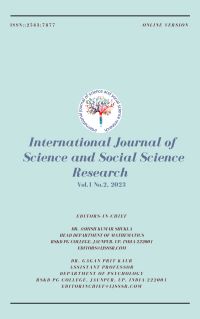
Visualizing the Invisible: Augmented Reality for Conceptualizing Molecular Geometries in Chemistry
DOI:
https://doi.org/10.63671/ijsssr.v1i2.25Keywords:
Augmented reality, conceptual understanding, educational technology, innovative instruction, molecular geometries, spatial, reasoningAbstract
Understanding three-dimensional molecular geometries is a pivotal aspect of chemistry, often challenging students due to the abstract nature of these structures. This study investigated the potential of augmented reality (AR) technology to enhance the conceptualization of molecular geometries among higher secondary students. A quasi-experimental research methodology was employed, involving a pre-test and post-test design with an experimental group using AR-based molecular visualization tools and a control group using traditional methods. The study aimed to assess the impact of AR on students' spatial reasoning skills, comprehension of molecular shapes, and overall learning outcomes. Data analysis revealed that students who engaged with AR-assisted learning demonstrated significantly improved spatial understanding and better grasp of molecular geometries compared to the control group. The findings highlighted the effectiveness of AR technology in bridging the gap between abstract concepts and tangible visualizations, particularly in the context of complex chemical structures. The implications of these findings are significant for educators seeking innovative strategies to enhance chemistry instruction and promote deeper conceptual understanding among higher secondary students.
Downloads
Published
Issue
Section
License
Copyright (c) 2023 International Journal of Science and Social Science Research

This work is licensed under a Creative Commons Attribution 4.0 International License.
How to Cite
Similar Articles
- Agam, Bhupesh Kumar, Evolutionary Roadmap: Latest Advancement in Designing Software to enhance designing capabilities , International Journal of Science and Social Science Research: Vol. 1 No. 4: January-March 2024
- Manashi Haloi, Prof. Brinda Bazeley Kharbirymbai, Integrating the Indian Knowledge System (IKS) into Teacher Education: A Transformative Approach under NEP 2020 , International Journal of Science and Social Science Research: Vol. 3 No. 2: July-September 2025
- Kalpana Satija, Manish Chhatlani, Assessing Gujarat’s Progress on SDG-10: An Economic Perspective , International Journal of Science and Social Science Research: Vol. 3 No. 3: October-December 2025
- N. Rajitha, K. Venugopala Rao, A Study on Work-Life Balance of Women Employees in the IT Sector: Exploring the Effects of Artificial Intelligence on Job Displacement , International Journal of Science and Social Science Research: Vol. 3 No. 4: January-March 2026
- Sarita Kumari, Combating malnutrition in Rural India , International Journal of Science and Social Science Research: Vol. 2 No. 3: October-December 2024
- N. Pautunthang, Understanding the Patterns of Marital Dissolution in Mizoram, India , International Journal of Science and Social Science Research: Vol. 4 No. 1: April-June 2026
- Muniisvaran Kumar, Franklin Thambi Jose. S, Kartheges Ponniah, Learning Tools for Tamil as a Foreign Language , International Journal of Science and Social Science Research: Vol. 4 No. 2: July-September 2026
- Amol .A. Jadhav, Sachin.S. Patil, Soniya Kadam, Research Paper on Study and Analysis Low Cost Housing , International Journal of Science and Social Science Research: Vol. 2 No. 1: April-June 2024
- Rifka Indi, The Bibiliometric Analysis of Bank Competition , International Journal of Science and Social Science Research: Vol. 3 No. 1: April-June 2025
- Sachin Kumar, From Imagination to Automation: How AI is Reshaping Students Creativity in the Digital Age , International Journal of Science and Social Science Research: Vol. 3 No. 4: January-March 2026
You may also start an advanced similarity search for this article.