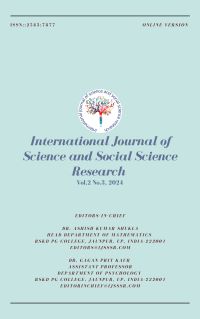
Developing AI Applications for Education: A Design Thinking Approach to Enhance Learning Experiences
DOI:
https://doi.org/10.63671/ijsssr.v2i3.182Keywords:
Machine Learning (ML), Design Thinking, User-Centered Design, Educational Technology, Personalized Learning, AI-Driven SolutionsAbstract
In the evolving landscape of machine learning (ML), traditional approaches often prioritize technical performance over user needs, leading to solutions that fail to address real-world requirements. To bridge this gap, the integration of design thinking principles into ML development has emerged as a promising approach. This paper explores the application of design thinking to ML, particularly in the educational sector, by focusing on creating user-centered solutions. We outline a methodology that combines empathy, problem definition, ideation, prototyping, and user feedback to ensure that ML solutions are both technically robust and aligned with user needs. Through a case study of an AI-driven personalized learning platform, we demonstrate how this approach can lead to more impactful and widely adopted solutions. We also discuss the benefits of such applications in education, including personalized learning, automated administrative tasks, and enhanced accessibility, while addressing challenges like ethical concerns and integration with existing systems. The paper concludes by highlighting the potential for this methodology to be applied across various industries, its role in advancing AI integration, and future research directions focusing on ethical design and scalability. By merging design thinking with machine learning, organizations can develop solutions that are innovative, user-centric, and effective in real-world applications.
Downloads
Published
Issue
Section
License
Copyright (c) 2024 International Journal of Science and Social Science Research

This work is licensed under a Creative Commons Attribution 4.0 International License.

How to Cite
Similar Articles
- Harsh Shukla, Kshama Pandey, Human-AI Collaboration in Teaching and Learning , International Journal of Science and Social Science Research: Vol. 2 No. 4: January-March 2025
- Agam, Bhupesh Kumar, Evolutionary Roadmap: Latest Advancement in Designing Software to enhance designing capabilities , International Journal of Science and Social Science Research: Vol. 1 No. 4: January-March 2024
- Muniisvaran Kumar, Franklin Thambi Jose. S, Kartheges Ponniah, Learning Tools for Tamil as a Foreign Language , International Journal of Science and Social Science Research: Vol. 4 No. 2: July-September 2026
- Laveena Ganwani, Database Normalization and Performance Prediction Using Linear Regression on a Student Dataset , International Journal of Science and Social Science Research: Vol. 3 No. 4: January-March 2026
- Vinod Kumar Kanvaria, Monika, Visualizing the Invisible: Augmented Reality for Conceptualizing Molecular Geometries in Chemistry , International Journal of Science and Social Science Research: Vol. 1 No. 2: July-September 2023
- Wasim Akram Khan, Molla Kaijar Hosseon, Md Shamim Golder, Chayan Adak, Bridging Play and Pedagogy: A Conceptual Framework for Gamification in Modern Education , International Journal of Science and Social Science Research: Vol. 3 No. 3: October-December 2025
- Mayank Jain, Saurav Kumar, Akshay Kumar, Exploring Radio Frequency Identification (RFID) Applications for Enhanced User Experience: Innovation in Library Technology , International Journal of Science and Social Science Research: Vol. 2 No. 2: July-September 2024
- Gaurav Dhiman, Harnessing Machine Learning and AI for Sustainable Development: Applications in Supply Chains, Cybersecurity, Climate Forecasting, and Economic Impact Analysis , International Journal of Science and Social Science Research: Vol. 2 No. 4: January-March 2025
- Arvind Kumar, Situ Kumari, Blended Learning and Educational Equity: A Thematic Analysis on Tribal and Gender-Inclusive Education , International Journal of Science and Social Science Research: Vol. 3 No. 1: April-June 2025
- Ajeet Kumar Yadav, Kusum Lata Patel, Teachers’ Perception towards the Use of Information and Communication Technology (ICT) in Secondary School , International Journal of Science and Social Science Research: Vol. 2 No. 1: April-June 2024
You may also start an advanced similarity search for this article.